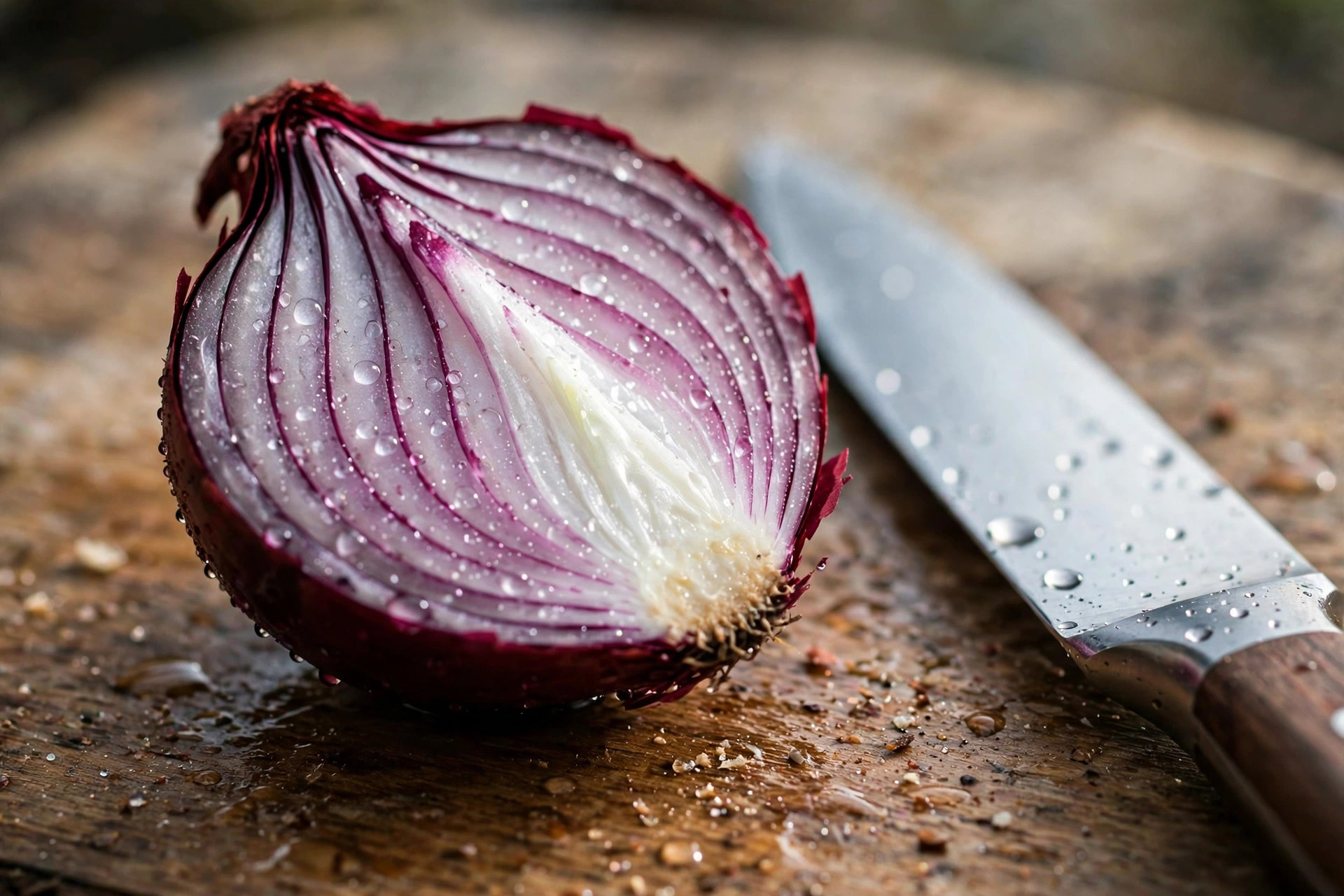
Slice into a raw onion and, within seconds, your eyes can start to sting and water. It is not the smell alone, and it is not a sign of a bad onion. It is chemistry, set in motion the moment a knife breaks the onion's cells. Understanding what is released, and why your eyes react to it, makes it much easier to judge which kitchen tricks are worth trying and which are mostly folklore.
What happens inside the onion when you cut it
An intact onion keeps its chemicals neatly separated. Sulphur-containing compounds sit in one part of the cell, while enzymes are held in another. As long as the onion is whole, nothing much happens. Cutting, chopping or crushing breaks those compartments open, and the contents mix for the first time.
That mixing starts a chain of reactions. Enzymes act on the sulphur compounds and produce a series of intermediate chemicals, including 1-propenesulfenic acid. A second enzyme, called lachrymatory factor synthase, then converts part of that into a volatile gas: syn-propanethial-S-oxide. This gas is the onion's lachrymatory factor — the substance largely responsible for making eyes water. The word lachrymatory simply refers to something that causes tears.
Because syn-propanethial-S-oxide is volatile, it escapes from the cut surface into the air and drifts upwards, which is why it so often reaches the face of the person doing the chopping.
Why your eyes water
When the gas reaches the surface of your eyes, it dissolves in the tear film and forms a mild acidic solution. Nerves in the eye detect this irritation and send a signal that triggers the tear glands. The tears are a protective response: they are your eyes trying to wash the irritant away and dilute it.
This also explains a few everyday observations. A finely chopped or crushed onion tends to cause more tears than a few clean slices, because more cells are damaged and more gas is released. An onion cut a while ago bothers you less over time, as the gas dissipates. And people who wear contact lenses sometimes report a slightly different experience, because the lens covers part of the eye surface, though this varies from person to person and is not a reliable method to copy.
Why some onions are worse than others
Not every onion makes you cry equally. The amount of tear gas produced depends on the onion's sulphur compounds, which vary by variety, freshness and growing conditions. In general, stronger, more pungent onions tend to produce more of the lachrymator than mild or sweet varieties, which were bred to be gentler in flavour. Older onions that have started to dry or sprout can also behave differently from firm, fresh ones. None of this changes the basic chemistry — it only changes how much gas you are dealing with.
What actually helps: well-supported tips
Chill the onion first
Refrigerating a peeled or halved onion for around 30 minutes before cutting is one of the better-supported tips. Cold slows the enzymatic reactions, and a cold onion releases its volatile gas less readily into warm air. It will not eliminate tears completely, but many cooks notice a clear reduction.
Use a sharp knife
A sharp knife slides through the onion and damages fewer cells than a blunt one, which crushes and tears its way through. Fewer damaged cells means less gas released. A sharp knife is also safer and gives cleaner slices, so this is good advice on every count.
Improve airflow and distance
Cutting near an extractor fan, an open window or a gentle fan blowing across the board carries the gas away before it reaches your eyes. Keeping your face back from the board, rather than leaning directly over it, helps for the simple reason that the gas has further to travel and more chance to disperse.
Cut the root end last
The basal plate, the root end of the onion, is often said to contain a higher concentration of the sulphur compounds. Leaving it intact while you slice the rest, and removing it at the end, can reduce how much gas is released early on. The evidence here is more practical than laboratory-tested, but the technique costs nothing and many cooks find it useful.
Commonly cited tips: mixed or folk territory
Cutting under water
Cutting an onion under running water, or submerged in a bowl of water, is commonly cited, and it does have a logic: the gas dissolves in water instead of rising into the air. In practice, though, wet onions are slippery, harder to grip safely and awkward to chop evenly. Rinsing a halved onion briefly before cutting is a safer compromise, though it helps less.
Cutting near a flame
The idea that cutting near a lit gas burner or candle draws in or burns off the gas is an old, commonly repeated tip. A flame does create an upward air current, which may pull some gas away, but there is little strong evidence that it neutralises the lachrymator. Treat it as a folk tip with a plausible airflow effect, not a proven fix, and never let it distract you while handling a knife near heat.
Bread, gum and other mouth tricks
Holding bread between your teeth, chewing gum or keeping your mouth open are frequently suggested. The theory is that breathing through your mouth, or absorbing gas with the bread, keeps it from your eyes and nose. These are folk tips: harmless for most people, but not well supported, and holding anything in your mouth while chopping is an unnecessary distraction.
Onion goggles
Sealed goggles work by a simple, physical principle — they stop the gas reaching your eyes at all. They look excessive in a home kitchen, but unlike many folk tips, the logic is direct. Ordinary glasses, by contrast, leave gaps and offer only partial protection.
A practical routine that combines what works
- Chill the onion in the fridge for about 30 minutes.
- Sharpen or choose your sharpest knife.
- Switch on the extractor or open a window before you start.
- Slice with the root end intact, and remove it last.
- Move chopped onion into a covered bowl away from your face as you work.
No single step is a guarantee. Combined, they reduce the amount of gas produced, slow its release and keep what is released away from your eyes — which is why this routine works better than any one dramatic trick.
Frequently Asked Questions
What is the chemical that makes you cry when cutting onions?
The main tear-causing gas is syn-propanethial-S-oxide, produced when an enzyme called lachrymatory factor synthase acts on sulphur compounds released from damaged onion cells.
Does chilling an onion really reduce tears?
Yes, it is one of the better-supported tips. Cold slows the reactions that produce the gas and reduces how readily it escapes into the air, though it does not stop tears completely.
Why does a sharp knife help?
A sharp knife cuts cleanly and damages fewer cells than a blunt knife that crushes the onion. Fewer damaged cells means less tear gas is released.
Do sweet onions make you cry less?
Generally, yes. Mild and sweet onion varieties tend to contain fewer of the pungent sulphur compounds, so they usually produce less of the tear-causing gas than strong onions.
Is cutting an onion near a flame proven to work?
No. It is a commonly cited folk tip. A flame creates an air current that may carry some gas away, but there is little strong evidence that it neutralises the gas.